How AI Coding Agents Are Changing Software Development in 2026
Coding agents moved from single-line autocomplete to handling multi-step tasks with real autonomy this year. Here's what actually changed, and where a human is still firmly in the loop.
For a few years, "AI coding tool" mostly meant autocomplete: it finished the line you were already typing. That's no longer the interesting part of this category. The tools that have gained real adoption this year are agents — given a task in plain language, they can read across an entire codebase, make changes in multiple files, run tests, and iterate on their own output before handing it back to you.
That's a meaningfully different way of working, and it comes with a different set of trade-offs than autocomplete ever did.
What actually changed
Three things came together to make agentic coding tools useful rather than gimmicky: models got noticeably better at holding and using long context, tools got better at giving models real access to a terminal and file system rather than just a chat window, and the models themselves got better at multi-step reasoning — planning an approach, trying it, checking whether it worked, and correcting course.
The practical result: you can now describe a feature in a sentence or two and get a genuine first attempt at implementing it across several files, not just a single function.
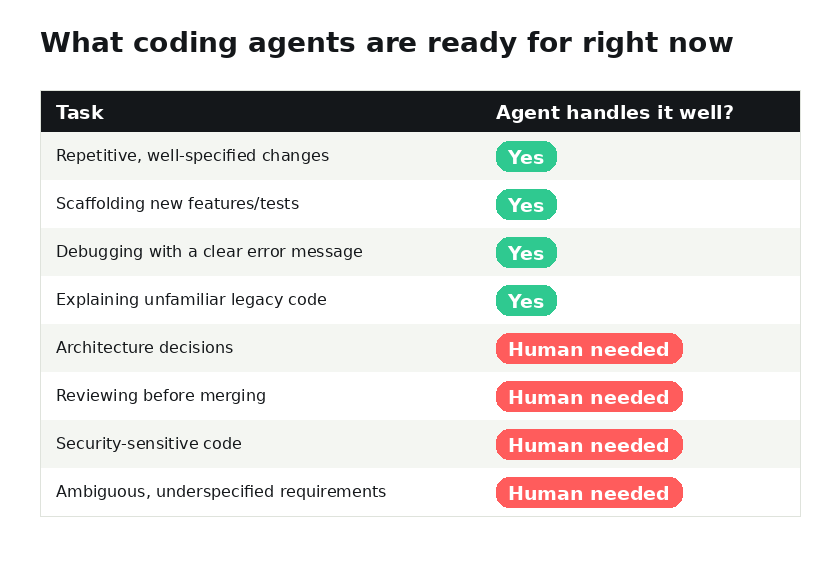
Where they're genuinely strong
- Repetitive, well-specified changes — renaming something consistently across a large codebase, updating a pattern that's used in dozens of places, or migrating from one library's syntax to another's.
- Scaffolding new work — setting up the boilerplate for a new feature, test file, or component so a developer starts from something functional instead of a blank file.
- Debugging with a clear error message — agents that can actually run the code and see the real error tend to converge on a fix faster than a human scanning the code by eye, especially for less familiar codebases.
- Explaining unfamiliar code — walking through what a legacy file actually does before you touch it, which used to be one of the slowest parts of onboarding onto an existing project.
Where a human is still essential
- Architecture decisions — how a system should be structured for the next two years of change, not just the next feature, is still a judgment call that benefits from experience an agent doesn't have.
- Reviewing before merging — agent-written code should go through the same review process as human-written code. Treating an agent's output as automatically trustworthy is where teams get burned.
- Security-sensitive code — anything touching authentication, payments, or user data deserves extra human scrutiny regardless of who or what wrote the first draft.
- Ambiguous requirements — agents do what you literally asked, which isn't always what you meant. Vague specs produce plausible-looking but wrong implementations more often than people expect.
How teams are actually adopting this
The teams getting the most value aren't the ones handing over entire features unsupervised — they're the ones using agents for a specific, bounded slice of the work (a migration, a test suite, a well-defined bug) while keeping a human reviewing every change before it ships. That middle ground, rather than full autonomy, is where most of the real productivity gains are showing up right now.
A specific example worth walking through
Take a common real task: migrating a codebase from one date-formatting library to another. This is exactly the kind of job agents handle well — the change is repetitive, the correct pattern is consistent across files, and success is easy to verify by running the existing test suite. A reasonable workflow: describe the migration and point the agent at the codebase, let it make the changes and run tests, then review the diff yourself before merging — rather than either doing all of it by hand or merging without looking.
Compare that to a vaguer ask like "make the checkout flow feel more modern." There's no clear definition of "done" here, no test that confirms success, and real product judgment involved — exactly the kind of ambiguous task where an agent's confident-sounding output can mask the fact that it guessed at what you actually wanted.
What to expect next
The trend line is toward agents handling larger, longer-running tasks with less hand-holding — but the trust question moves at a different pace than the capability question. Expect the tooling around review, testing, and safe rollback to keep maturing alongside the agents themselves, because that's what actually determines whether teams feel comfortable giving them more autonomy. For one specific, fast-growing example of this category, see our spotlight on OpenCode, an open-source agent that's taken a notably different approach — letting developers choose their own underlying model rather than being locked into one provider.
Frequently asked questions
Will AI coding agents replace developers?
Not in the way that framing suggests. They're changing what a developer spends time on — less on repetitive implementation, more on review, direction, and the judgment calls agents can't make — rather than removing the role.
Is it safe to let an agent commit code directly?
Most teams still route agent-written changes through the same review and testing process as human-written code, rather than allowing direct commits to production branches. That's a reasonable default until you have a lot of trust built up with a specific tool on a specific codebase.
Do I need a large codebase to benefit from these tools?
No — they're useful on small projects too, particularly for scaffolding and explaining unfamiliar code. The multi-file, agentic advantage becomes more pronounced as a codebase grows, but there's value at any size.