Nobel Prizes 2026: Every Winner and What They Actually Discovered
Six prizes were announced between 5 and 12 October. Here is who won, in plain language, and why the work matters beyond the headline.
Every October, the Nobel announcements trigger a wave of searches: who won, and what did they actually do? The 2026 round covered a controlled-light method for studying the brain, a telescope buried in Antarctic ice, a century-old puzzle about mirror-image molecules, a poet who rewrites the classics, a lifelong judge of war crimes, and the economics of stabilising a shaky economy.
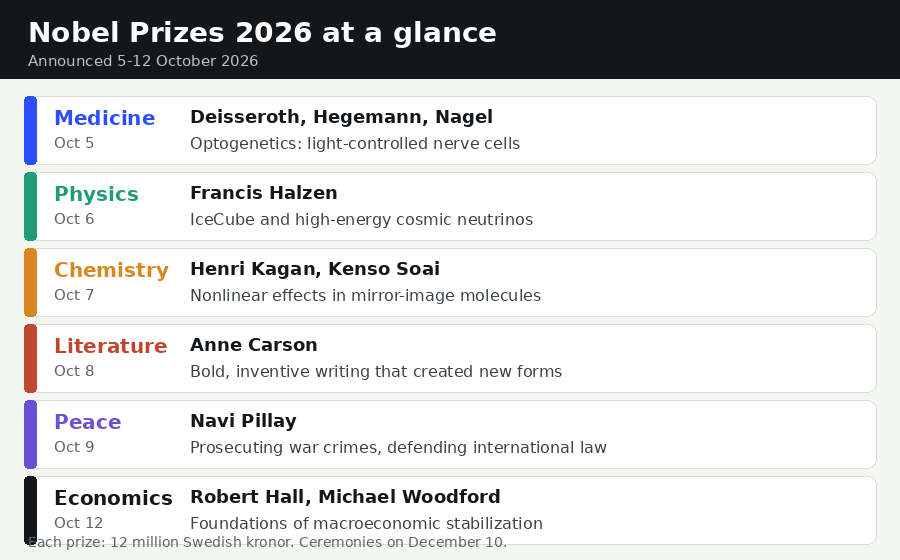
Quick reference: all 2026 winners
| Prize | Laureate(s) | Announced | Recognised for |
|---|---|---|---|
| Physiology or Medicine | Karl Deisseroth (US), Peter Hegemann, Georg Nagel (Germany) | Oct 5 | The discovery of a molecular switch for nerve cells (optogenetics) |
| Physics | Francis Halzen | Oct 6 | Contributions to the IceCube Neutrino Observatory and discovery of high-energy neutrinos of astrophysical origin |
| Chemistry | Henri Kagan (France), Kenso Soai (Japan) | Oct 7 | Nonlinear effects and autocatalysis in asymmetric organic synthesis |
| Literature | Anne Carson (Canada) | Oct 8 | A bold and inventive body of work that created new forms for contemporary literature |
| Peace | Navanethem (Navi) Pillay (South Africa) | Oct 9 | Helping ensure that war crimes, crimes against humanity and genocide are prosecuted |
| Economic Sciences | Robert E. Hall, Michael Woodford (US) | Oct 12 | Research on how to stabilise economies against shocks |
Medicine: a light switch for nerve cells
Karl Deisseroth of Stanford, Peter Hegemann of Humboldt University in Berlin, and Georg Nagel of the University of Würzburg shared the prize for what the Nobel Assembly called "a molecular switch for nerve cells." The field is called optogenetics. Researchers add light-sensitive proteins to chosen nerve cells, then use light to switch those cells on or off in a living brain.
Why it matters: it lets scientists test which cells are responsible for behaviours such as learning, fear, addiction and movement, instead of guessing from broad brain activity. The committee said optogenetics "has fundamentally altered our understanding of the brain." Researchers also hope it could lead to more precise cochlear implants.
Physics: catching neutrinos from deep space
Francis Halzen, 82, of the University of Wisconsin–Madison, won for his contributions to the IceCube Neutrino Observatory and the discovery of high-energy neutrinos of astrophysical origin. Neutrinos are particles that pass through almost everything, which makes them hard to detect but useful: unlike light, they travel straight from violent cosmic events without being blocked or bent. Detecting them gives astronomers a new way to look at the universe.
Chemistry: why molecules have a handedness
Henri Kagan of France (95) and Kenso Soai of Japan (76) were honoured for the discovery of nonlinear effects and autocatalysis in asymmetric organic synthesis. Some molecules exist in two mirror-image forms, like a left and right hand. Living things use almost only one form, a pattern chemists have puzzled over for more than a century.
This is not only abstract. In medicine, the two forms of a molecule can act differently in the body, so chemists need ways to make just one. The committee chair said the work offers a route to understanding how a single hand can come to dominate on its own.
Literature: Anne Carson
The Canadian poet, essayist and classicist Anne Carson, 76, won for what the Swedish Academy described as a "bold and inventive oeuvre" that has "created new forms for contemporary literature." She is known for blending verse, prose, dialogue and translation. Notable works include the verse novel Autobiography of Red (1998) and Norma Jeane Baker of Troy (2019), which combines Euripides' Helen with the story of Marilyn Monroe.
Peace: Navi Pillay
The Norwegian Nobel Committee announced the Peace Prize on 9 October in Oslo. It went to Navanethem "Navi" Pillay, a South African jurist aged 85 and of Indian Tamil origin. She opened a law practice in Natal in 1967 as its first woman, defended anti-apartheid activists, served on the International Criminal Tribunal for Rwanda and the International Criminal Court, and later led the UN human rights office. The committee said she helped ensure that war crimes, crimes against humanity and genocide are prosecuted. The committee received 287 nominations.
As with many Peace Prizes, the choice drew mixed reactions from governments and commentators. We report the committee's stated reasoning and leave the political debate to the sources linked below.
Economics: stabilising economies
The Sveriges Riksbank Prize in Economic Sciences, announced 12 October, went to American economists Robert E. Hall and Michael Woodford. News reports describe their research as explaining how household and firm decisions shape the policies used to deal with inflation, recessions and shocks. If you want the full official wording, check the Nobel Prize website.
What happens next
The laureates receive their medals and diplomas on 10 December in Stockholm, with the Peace Prize presented in Oslo. Winners usually give a Nobel lecture beforehand. If you are interested in science that quietly changes everyday tools, see our look at how machine learning works, and for reading habits that save time, our productivity tools guide.
Frequently asked questions
How much is each Nobel Prize worth in 2026?
Each prize is 12 million Swedish kronor, roughly 1.2 million US dollars. When a prize is shared, the amount is divided among the laureates.
When are the 2026 Nobel Prizes presented?
Laureates receive their awards on 10 December, the anniversary of Alfred Nobel's death, in Stockholm and Oslo (the Peace Prize is presented in Oslo).
Is the Economics prize a real Nobel Prize?
It is officially the Sveriges Riksbank Prize in Economic Sciences in Memory of Alfred Nobel. It was established later than the original five prizes but is announced and presented alongside them.
Who chooses the winners?
Different bodies decide: the Karolinska Institute's Nobel Assembly for Medicine, the Royal Swedish Academy of Sciences for Physics, Chemistry and Economics, the Swedish Academy for Literature, and the Norwegian Nobel Committee for Peace.
Sources
Facts above were compiled from reports by Al Jazeera (Medicine), Deccan Chronicle (Physics), Al Jazeera (Chemistry), SCMP (Literature), Al Jazeera (Peace) and Chronicle India (Economics). Official details: nobelprize.org.